World's First Methanol Escort Tug Heads For British Columbia
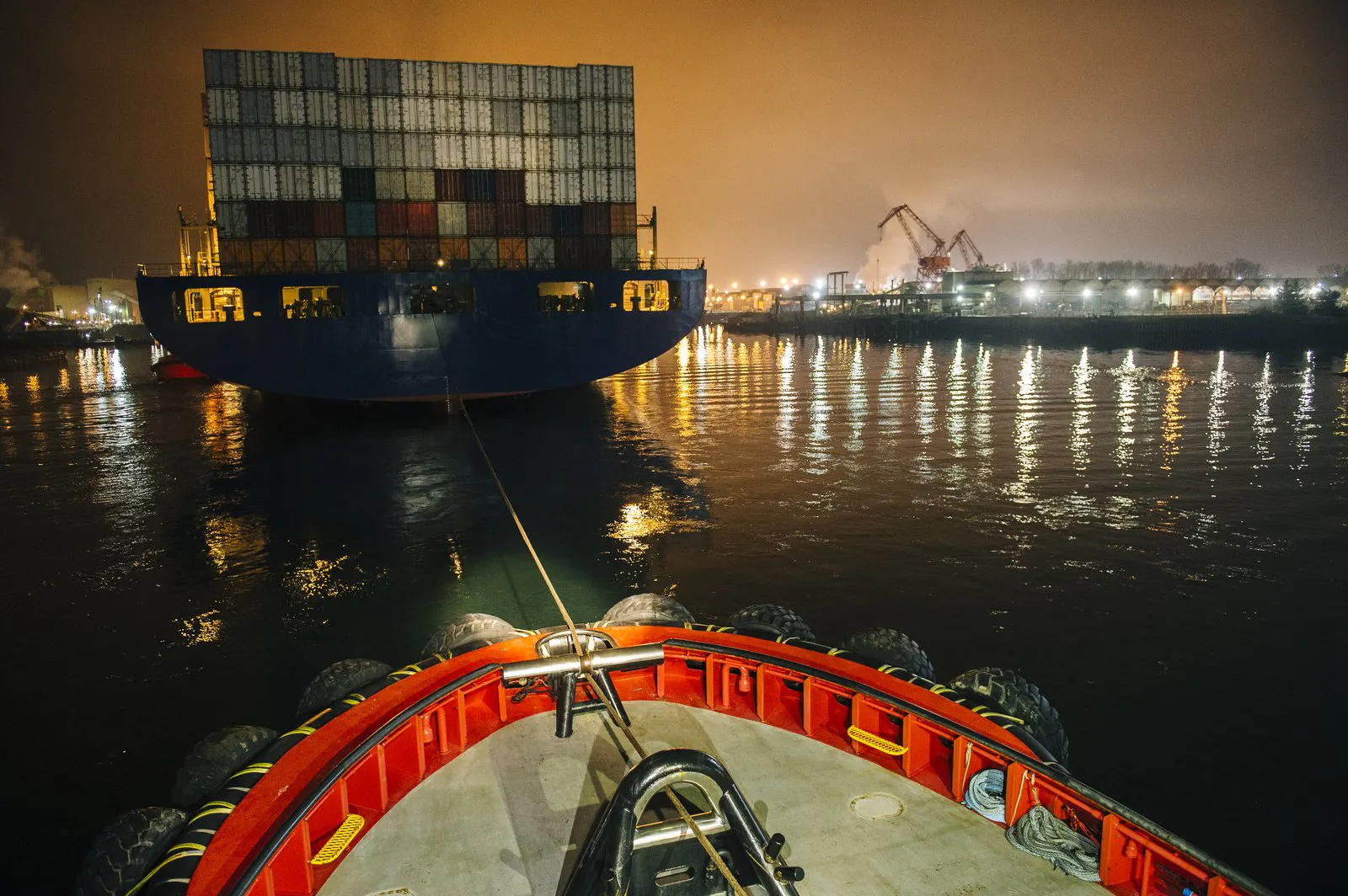
The escort tug SD Aisemaht, described as the world's first purpose-built dual-fuel methanol tug of her type, has been spotted west of Gibraltar bound for Las Palmas on the first stage of a delivery voyage to Canada. Built by Sanmar Shipyards to a Robert Allan design for Kotug Canada, the vessel represents the first application of methanol propulsion to a class of workboat where power density and instantaneous response matter more than in almost any other segment of the industry.
The 44-metre tug is based on the RAsalvor 4400-DFM platform and delivers more than 120 tonnes of bollard pull, placing her among the most powerful tugs operating in Canada. The propulsion system pairs dual-fuel methanol main engines with Schottel's Sydrive-M mechanical hybrid arrangement driving two azimuth thrusters, a combination that allows the vessel to draw on different power paths depending on whether she is transiting, standing by or working at full escort load.
That flexibility addresses the central difficulty with alternative fuels in the tug sector. Harbour and escort tugs spend the majority of their operating hours at very low load, punctuated by short periods at or near maximum output, a profile that suits neither a conventional engine sized for peak demand nor a battery system sized for endurance. A hybrid arrangement lets the vessel run efficiently across both extremes, and pairing it with methanol gives the operator a fuel that can be handled at ambient temperature and pressure, unlike the cryogenic alternatives.
The tug has been built for demanding work along the coast of British Columbia, covering long-range towing, escorting, anchor handling and emergency response. She is fully equipped with firefighting and oil spill response systems and will play a central role in supporting tanker operations connected with the Trans Mountain Expansion Project, where crude exports from Vancouver have grown substantially and where escort requirements are among the most stringent applied anywhere.
The context makes the fuel choice more than a demonstration. Escort tugs on that coast exist because the regulatory and political settlement around tanker traffic depends on visible, credible spill prevention, and an operator that can also point to a substantially lower-emission escort fleet strengthens its position in a debate that has never fully settled. Whether methanol becomes standard for tug newbuildings will depend on bunkering availability at working ports rather than on the technology, which this vessel has now demonstrated at full escort power.