Three-Year Lashing Bridge Trial Puts Polyurethane Ahead of Epoxy
Corrosion at 0.3% against 15% on the comparison coating aboard a 15,300 teu boxship
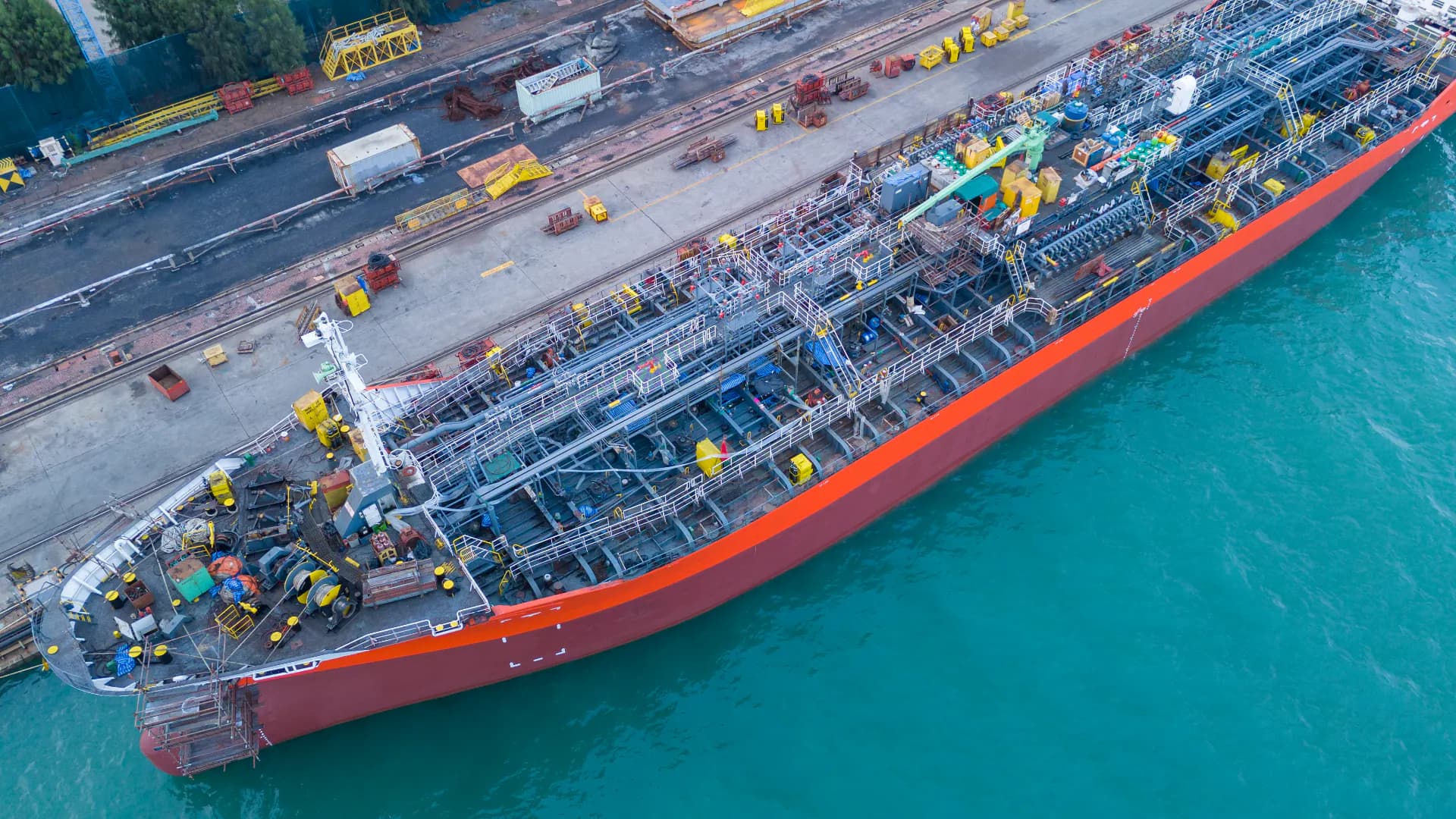
A three-year coating trial aboard the 15,300 teu container ship Maersk Hamburg has found significantly less corrosion and coating damage on a lashing bridge protected with Steelpaint's moisture cure polyurethane system than on the same area protected with a conventional epoxy system.
In March 2023, Maersk Line applied the Stelpant coating and an epoxy system from Hempel, both including a zinc-rich primer and a topcoat, to lashing bridge Bay No 74 during a scheduled drydocking at Qingdao Beihai Shipyard. The coatings were selected to minimise crew maintenance and avoid repeated repairs in areas subject to heavy mechanical damage from twistlocks and lashing rods during cargo operations.
The Steelpaint system comprised 80 microns of Stelpant-PU-Zinc and 150 microns of Stelpant-PU-Combination 300, for a total dry film thickness of 230 microns. The Hempel system was based on 75 microns of Hempadur Avantguard 750 and 175 microns of Hempadur Mastic, for a larger film thickness of 250 microns. Both were exposed to the same impact and operating conditions.
At an inspection at Xiamen in July 2026, inspectors reported 0.3% corrosion on the Steelpaint area, up slightly from 0.1% after the first year. Corrosion on the epoxy-coated area increased from 5% to 15% over the same period. First-coat impact damage rose from 1% to 3% on the polyurethane system and from 10% to 30% on the epoxy; second-coat damage rose from 10% to 15% and from 15% to 40% respectively. The report notes that the epoxy coating had been regularly maintained by the crew, while the polyurethane coating required no maintenance at all across the three years.
"After three years there is almost no corrosion but there was significant corrosion and impact damage on the lower part of the lashing bridge protected by the epoxy coating," said Steelpaint director Frank Muller. Where the topcoat had been removed, the PU-Zinc primer remained intact, and where the primer had been abraded, 30 to 50 microns of zinc remained attached to the steel with no corrosion observed. Under more intensive impact, around 10 to 30 microns remained on the steel profile with only very slight corrosion reported.
The epoxy behaved differently under impact, with instances of the complete system peeling from the substrate, cracking and brittle behaviour, and corrosion where steel became exposed. After three years the Steelpaint system measured 180 to 320 microns with no significant change, while the Hempel system measured 600 to 1,000 microns after multiple touch-ups.
Ships in this story