MSC Boxship Partially Sinks At Zhoushan Repair Berth
A container ship belonging to the world's largest liner operator has partially sunk alongside a repair yard at Zhoushan in eastern China, after a grounding during a typhoon that salvors were unable to reverse. The MSC Silvana VIII, a Cyprus-flagged vessel of around 8,401 container capacity and 332 metres in length, arrived at the yard on 22 June from Gwangyang and was still there when the weather closed in.
The vessel touched bottom on 11 or 12 July during Typhoon Bavi, and the damage that followed was progressive rather than sudden. An attempt to refloat her failed, and in early August her stern settled with cargo holds and the engine room flooded. Roughly three thousand tonnes of fuel have been removed from the ship. Satellite imagery continued to show a fuel oil sheen in the area as late as 7 August, indicating that the removal operation had not captured everything that escaped.
Basic facts remain unavailable. The exact date of the partial sinking is given as 4 August in one tracking record and described only as early August in trade reporting. No Chinese maritime authority has been quoted on the casualty, the operator has not commented publicly, and the cargo aboard, the volume spilled, the salvage contractor and any injuries are all unreported. No casualties have been reported, which is not the same as a confirmation that no one was hurt, and the distinction matters when the primary sources are commercial tracking services rather than an investigating authority.
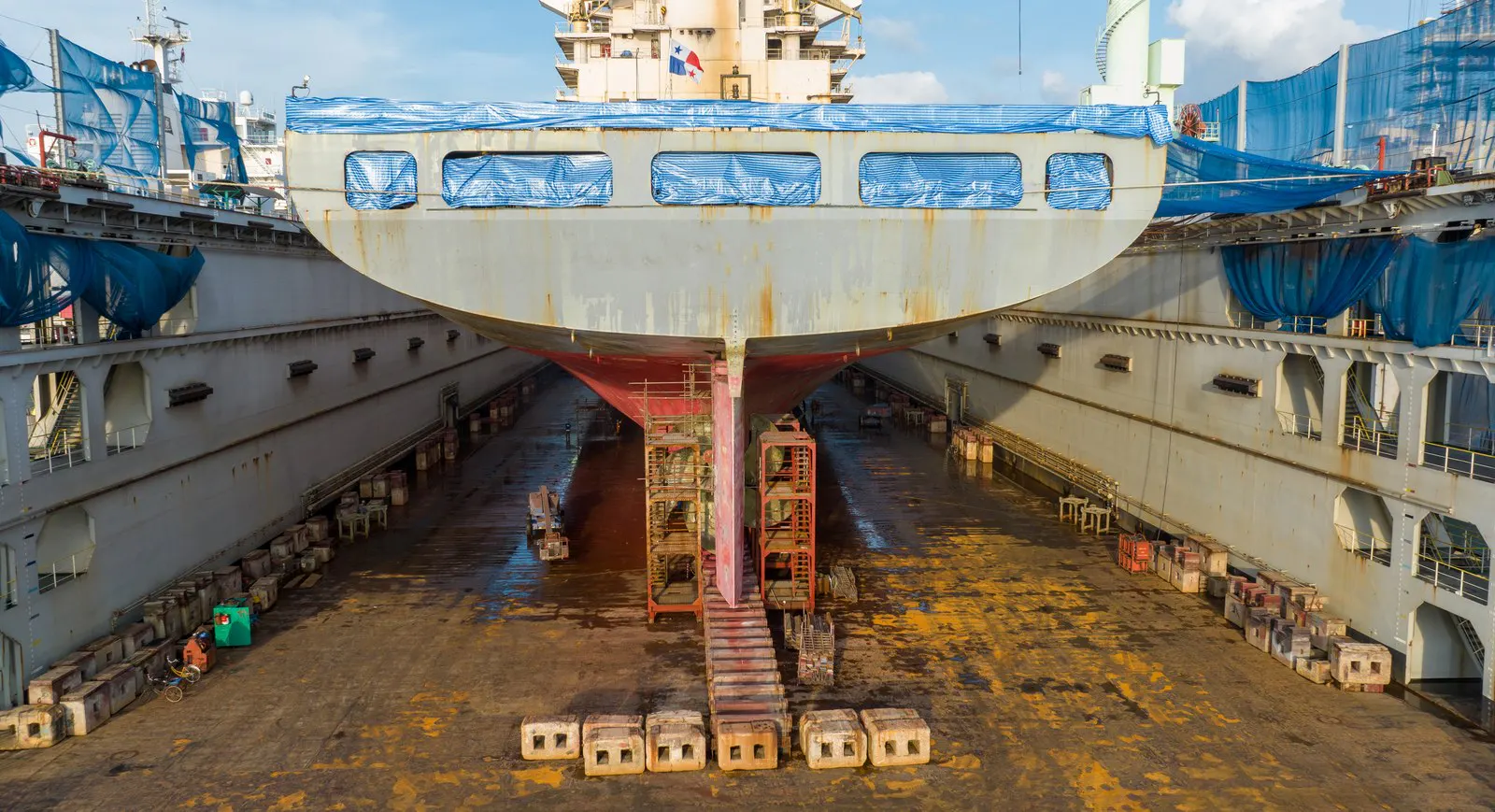
The setting is what makes the case awkward. A ship in a repair yard is at her most vulnerable: tanks may be opened, machinery is stripped, watertight integrity is compromised by the work itself, and the crew complement is reduced to a fraction of a seagoing manning level. A yard berth is also chosen for access rather than for shelter. When a typhoon arrives, the vessel that would normally have gone to sea or to a designated anchorage has no ability to do either, and the decisions about where to place her fall to a yard rather than to a master.
The salvage has been running against the weather ever since. A further typhoon threatened the site while the operation was under way, and the ship lies alongside a channel of forty to fifty metres, which limits both the equipment that can be brought in and the tolerance for anything going wrong. A twenty-year-old vessel with a flooded engine room in a working yard is a slow, expensive job, and the absence of any official statement on it a month after the initial grounding is conspicuous.