Rotterdam and Antwerp-Bruges still dwarf every other EU port on tonnage
EU ports moved 3.4 billion tonnes in 2024, a quarter of all seaborne trade, and two of them took a fifth of it
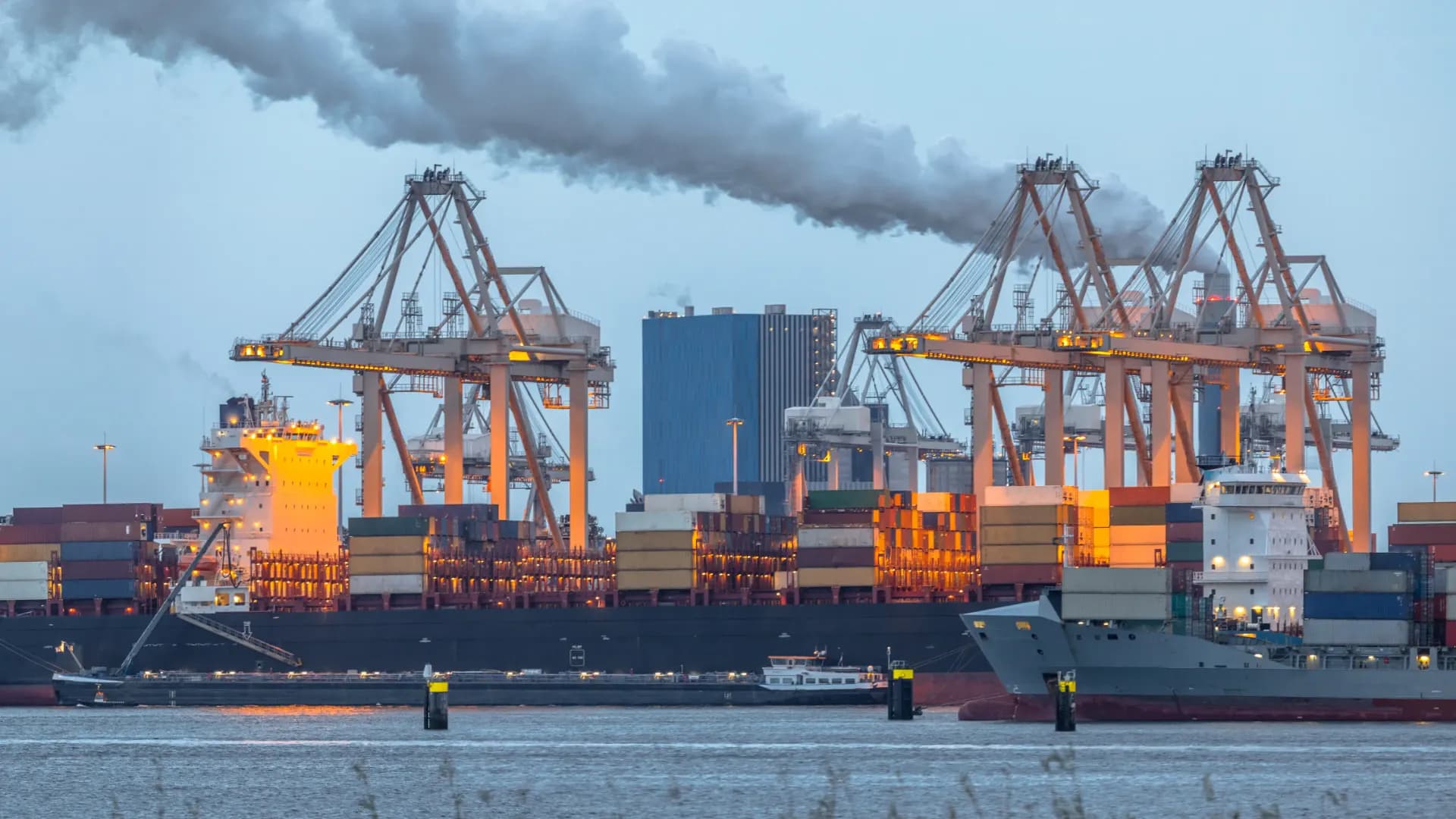
European Union ports handled around 3.4 billion tonnes of goods in 2024, roughly 26% of the 13 billion tonnes moved by sea worldwide that year. Almost 90% of the bloc's external freight trade travels by water.
Rotterdam remains the busiest single port in the Union by a wide margin, with 397.3 million tonnes of goods moved to and from the port. Antwerp-Bruges follows on 243.7 million tonnes. Between them the two handle close to a fifth of everything the bloc's ports touch.
The drop to third place is the striking part of the table. Hamburg handled 97 million tonnes, less than a quarter of Rotterdam's volume and well under half of Antwerp-Bruges. Below the top two the curve flattens immediately and the differences between ports become small.
Spain's Algeciras is fourth on 81.5 million tonnes, and Amsterdam completes the top five at 78.8 million. France's busiest, HAROPA, combining Le Havre and Rouen, ranks sixth at 76.6 million tonnes, with Gdansk close behind on 71 million. Marseille is also inside the top ten at 66 million tonnes, Valencia at 64.5 million, and Romania's Constanta at 57.6 million.
Ranks 11 to 20 span a narrow band, from 36.8 million tonnes at Dunkerque to 55.5 million at Barcelona. Trieste is the busiest Italian port at 53.5 million tonnes, ahead of Genova at 47.4 million. Sines in Portugal handled 44.1 million tonnes, Piraeus 43.7 million, Bremerhaven 42.5 million and Goteborg 38.5 million. The underlying figures are published in the Eurostat maritime transport collection, in the goods handled dataset.
Read by country rather than by port, the Netherlands leads the Union at 538.1 million tonnes. Italy is second at 488.6 million and Spain close behind at 486 million, both of them reaching those totals through several mid-sized ports rather than one dominant gateway. Fourth-placed Belgium handled 274.9 million tonnes.
The split between short sea and deep sea matters when reading the table. For EU purposes short sea shipping covers more than intra-bloc movements: it takes in candidate countries, Iceland, Norway, and the Baltic, Mediterranean and Black Sea areas. A port's total therefore mixes intercontinental cargo with feeder and regional traffic, and two ports on similar tonnage can be doing very different work.
This story is part of the Maritime Briefing of 11 September 2026.