South Korea's Big Three Yards Are Running Above Their Rated Capacity
First-half operating rates of 106.1%, 100.2% and 100% are being held up by overtime, night shifts and holiday working
South Korea's three largest shipbuilders are running at or beyond their rated production capacity, and are responding with equipment investment and automation rather than with new ground.
HD Korea Shipbuilding and Offshore Engineering, Samsung Heavy Industries and Hanwha Ocean reported average operating rates for the first half of 2026 of 106.1 percent, 100.2 percent and 100 percent respectively. The operating rate compares actual working hours against a baseline of normal production or target operating hours, so a figure above 100 percent means output has passed what standard hours allow, sustained through overtime, holiday working and night shifts.
The difficulty is that full capacity is still not enough to absorb the order flow, and there is concern within the industry that a shortage of capacity will cost the yards newbuilding contracts they would otherwise win. Delivery schedules at the major yards are largely filled through 2029, with some orders extending into 2030.
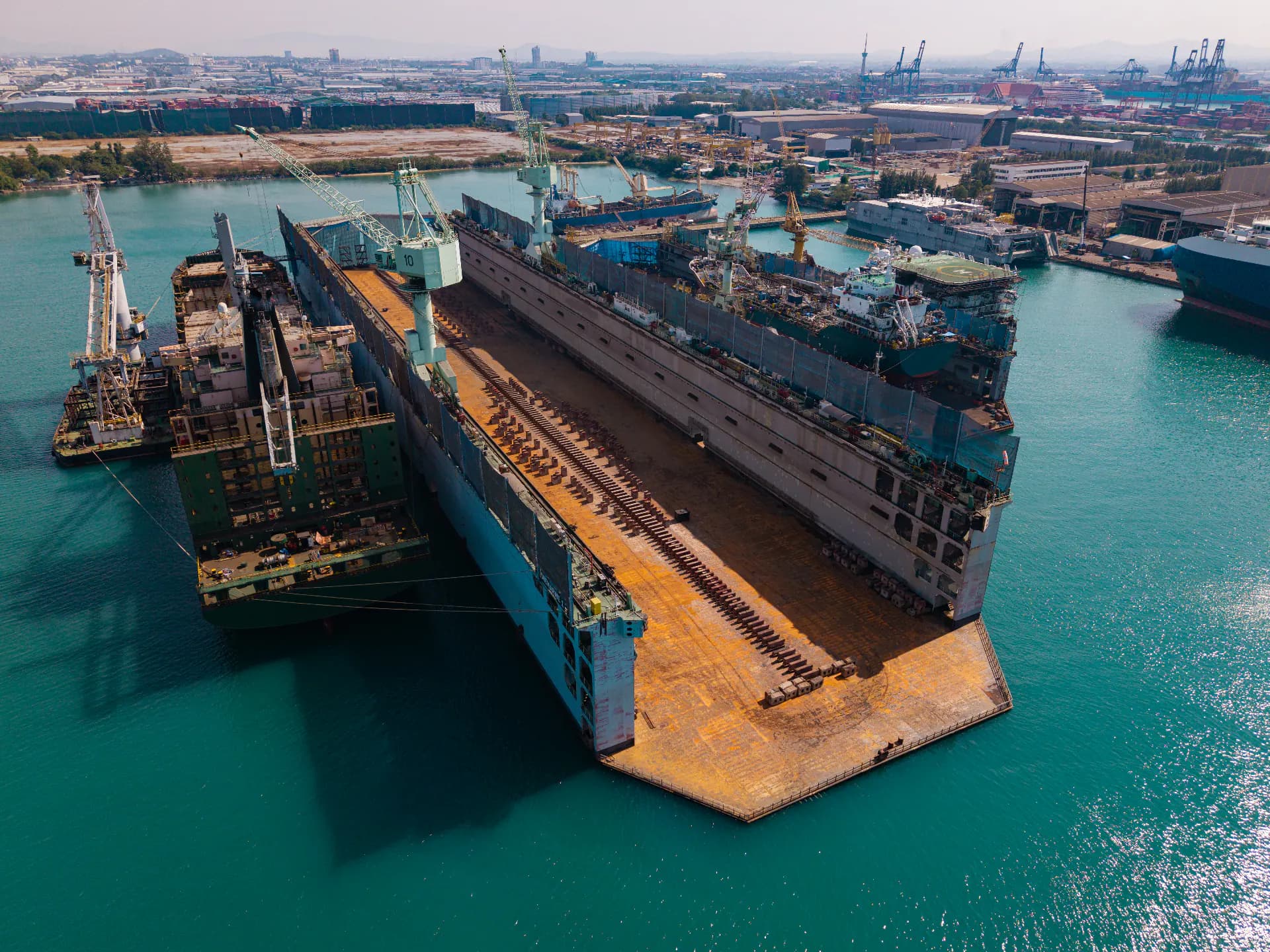
Hanwha Ocean plans to invest KRW686.9bn in the second half of 2026 to upgrade shipbuilding facilities and to add a very large floating dock and a large offshore crane by March 2027, reducing its reliance on leased equipment. It is also extending welding automation, centred on its Geoje yard, where the adoption rate for automation in indoor welding processes has reached 67 percent against a target of complete automation by 2030.
Samsung Heavy Industries invested KRW99.2bn in equipment in the first half and plans a further KRW330.8bn in the second, working towards what it describes as a smart, autonomous and unmanned shipyard by 2030 under a strategy combining digital, artificial intelligence and robotics programmes. Its intelligent pipe manufacturing centre began operations in the first half, automating design, logistics, processing, measurement, alignment and welding for pipe components with an annual output of approximately 100,000 pipe segments.
HD KSOE has invested KRW142bn in facility upgrades including the replacement of ageing cranes, with a further KRW152.6bn planned for the second half. Its Future of Shipyard project, scheduled for completion by 2030, applies digital twins, artificial intelligence and large-scale data analysis, and is expected to raise overall productivity by 30 percent and shorten the build cycle by the same proportion.
None of the three is expanding physical capacity aggressively, and the reason is the industry's own history. Shipbuilding alternates between booms and downturns, and capacity added on the strength of a peak becomes a fixed cost carried through the trough that follows. That caution is the main reason the utilisation figures are being met with cranes and software rather than with new docks.